
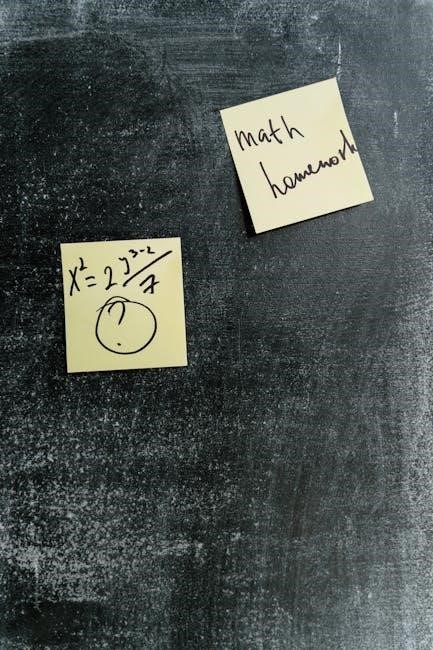
Foundations of Mathematics 11 Textbook PDF: A Comprehensive Plan
Foundations of Mathematics 11 is a comprehensive educational resource, totaling 595 pages and measuring 27 cm in size. This textbook, available as a PDF,
offers a robust curriculum designed to enhance mathematical understanding for students. It includes a CD-ROM component for interactive learning.

Overview of the Textbook
Foundations of Mathematics 11 serves as a pivotal resource for students navigating advanced high school mathematics. This textbook, meticulously crafted by a team of writers and consultants, aims to deliver a superior learning experience. The content spans 595 pages, presented in a 27 cm format, and is designed to build a strong mathematical foundation.
The textbook’s core focuses on several key areas, including inductive and deductive reasoning, the properties of angles and triangles, and trigonometric principles applicable to both acute and oblique triangles; Furthermore, it delves into statistical reasoning, systems of linear inequalities, quadratic functions and equations, and the principles of proportional reasoning.
Accompanying the printed text is a CD-ROM, enhancing the learning process with interactive elements. The textbook is intended to be a comprehensive guide, fostering a deep understanding of essential mathematical concepts and skills. It’s a valuable asset for both students and educators alike, promoting mathematical literacy and problem-solving abilities.
Availability on the Internet Archive
Foundations of Mathematics 11 is readily accessible through the Internet Archive, offering a valuable resource for students and educators seeking digital access to this textbook. The Internet Archive provides free access to this educational material, supporting a commitment to retain and provide access to knowledge.
The archived version of the textbook is an access-restricted item, initially added on May 24, 2021. Its item size is substantial, weighing in at 1.4GB, reflecting the comprehensive nature of the content. Users can download, borrow, and stream the textbook directly from the Internet Archive platform.
This digital availability ensures wider reach and accessibility, particularly for those who may not have immediate access to a physical copy. The Internet Archive’s platform allows for easy searching of metadata and text contents, facilitating efficient learning and research. The resource is preserved for future use, contributing to the long-term availability of this important educational material.
Publication Details
Foundations of Mathematics 11 was published by Nelson Education, located in Toronto, Ontario. The textbook’s publication date is noted as April 24, 2021, on the Internet Archive, indicating when the digital version was archived for preservation and access. This specific edition represents a significant contribution to mathematics education within the Canadian curriculum;
The textbook’s development involved a collaborative effort from numerous writers and consultants, all dedicated to delivering the highest quality mathematics education. This collaborative approach ensures a comprehensive and well-rounded presentation of mathematical concepts. The publication details highlight the commitment to providing students with a robust learning experience.
The Internet Archive listing categorizes the textbook under various topics, reflecting its broad scope. The inclusion of a CD-ROM, measuring 4 ¾ inches, alongside the printed text, signifies an early integration of technology into the learning process. This publication aims to equip students with a strong foundation in mathematical principles.
Textbook Size and Format
Foundations of Mathematics 11 presents as a substantial physical textbook, measuring 27 centimeters in height. The complete volume encompasses a total of 595 pages, indicating a comprehensive and detailed treatment of the subject matter. This considerable length suggests a thorough exploration of various mathematical concepts and principles.
Beyond the printed format, the textbook is also available as a digital PDF through the Internet Archive, offering accessibility and convenience for students and educators. The digital version is a sizable 1.4 Gigabytes in size, reflecting the inclusion of detailed diagrams, examples, and potentially interactive elements.
Furthermore, the textbook is accompanied by a 4 ¾ inch CD-ROM, enhancing the learning experience with supplementary materials. This combination of physical textbook, digital PDF, and CD-ROM provides multiple avenues for students to engage with the content and solidify their understanding of foundational mathematical concepts.
Core Mathematical Topics Covered
Foundations of Mathematics 11 delivers a broad curriculum encompassing several key areas of mathematical study. The textbook systematically explores inductive and deductive reasoning, laying the groundwork for logical thinking and problem-solving skills. A significant portion is dedicated to the study of properties of angles and triangles, essential for geometry and trigonometry.
The text further delves into trigonometric functions, specifically focusing on acute triangle trigonometry and extending to oblique triangle trigonometry, providing students with tools for analyzing non-right triangles. Statistical reasoning is also a core component, equipping students with the ability to interpret and analyze data.
Additionally, the textbook covers systems of linear inequalities, quadratic functions and equations, and proportional reasoning. These topics build upon foundational concepts and prepare students for more advanced mathematical studies. The comprehensive nature of these topics ensures a well-rounded mathematical education.
Inductive and Deductive Reasoning
Foundations of Mathematics 11 places significant emphasis on the development of logical reasoning skills, specifically inductive and deductive reasoning. Inductive reasoning is presented as a method of forming generalizations based on observed patterns and examples, encouraging students to identify trends and make informed conjectures.
Conversely, the textbook meticulously explains deductive reasoning, focusing on the application of established rules and axioms to arrive at logically certain conclusions. Students learn to construct valid arguments and proofs, building a strong foundation in mathematical rigor.
The text provides numerous examples and exercises designed to hone these skills, enabling students to differentiate between valid and invalid arguments. This section aims to cultivate critical thinking abilities, essential not only for mathematical success but also for problem-solving in various real-world contexts. Mastering these reasoning types is fundamental to the entire curriculum.
Properties of Angles and Triangles
Foundations of Mathematics 11 dedicates a substantial portion to exploring the properties of angles and triangles, forming a cornerstone of the geometric concepts covered. The textbook systematically introduces various angle relationships, including complementary, supplementary, and vertical angles, providing clear explanations and illustrative diagrams.
Triangle properties are examined in detail, encompassing angle sum theorems, exterior angle theorems, and congruence postulates (such as SSS, SAS, and ASA). Students learn to classify triangles based on their angles and sides, and to apply these classifications in problem-solving scenarios.

The material progresses to explore the relationships between angles and sides within triangles, including the Law of Sines and Law of Cosines, preparing students for more advanced trigonometric concepts. Numerous practice exercises reinforce understanding and build proficiency in applying these geometric principles.
Acute Triangle Trigonometry
Foundations of Mathematics 11 introduces acute triangle trigonometry as a fundamental application of ratios within right-angled triangles. The textbook meticulously defines the three primary trigonometric ratios – sine, cosine, and tangent – relating them to the sides opposite, adjacent, and hypotenuse of an acute triangle.
Students learn to determine these ratios for various angles and utilize them to calculate unknown sides and angles within acute triangles. Emphasis is placed on understanding the unit circle and its connection to trigonometric functions. The textbook provides numerous examples demonstrating the practical application of these concepts.
Problem-solving strategies are developed through a series of exercises, ranging from basic ratio calculations to more complex applications involving real-world scenarios. The material builds a strong foundation for understanding more advanced trigonometric concepts and their applications in various fields.
Oblique Triangle Trigonometry
Foundations of Mathematics 11 extends trigonometric principles beyond right triangles to encompass oblique triangles – those lacking a 90-degree angle. The textbook introduces the Law of Sines and the Law of Cosines as essential tools for solving these triangles.
Students learn to apply these laws to determine unknown sides and angles when presented with sufficient information, such as side-angle-side (SAS), angle-side-angle (ASA), or side-side-side (SSS) configurations. The text emphasizes the importance of identifying ambiguous cases where multiple solutions may exist.
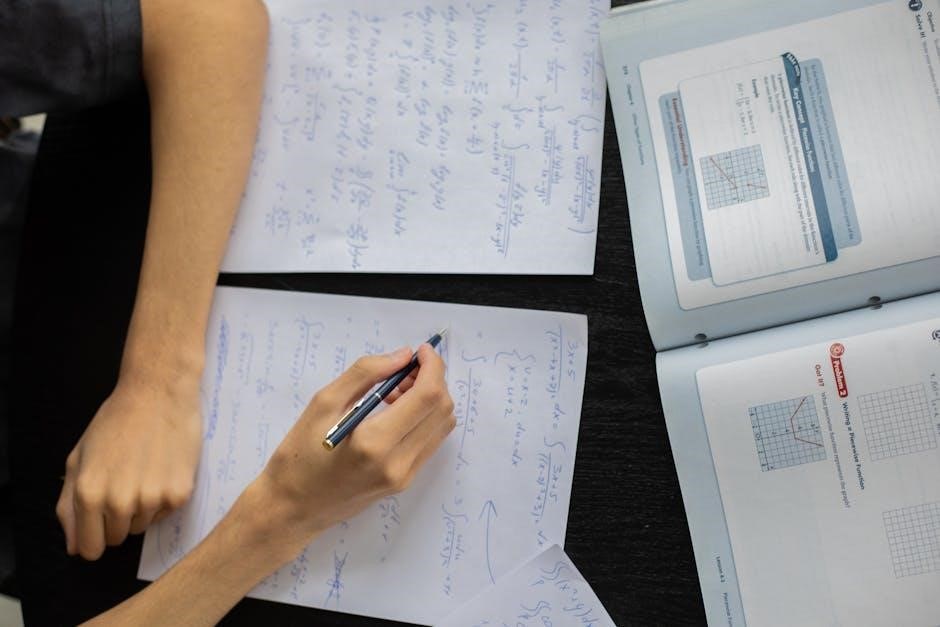
Detailed examples illustrate the application of these laws in practical contexts, including navigation, surveying, and engineering. The textbook also explores the concept of area calculation for oblique triangles, providing students with a comprehensive understanding of trigonometric principles applicable to non-right-angled triangles. Problem-solving exercises reinforce these concepts.
Statistical Reasoning
Foundations of Mathematics 11 dedicates a significant portion to developing students’ statistical reasoning skills. This section introduces fundamental concepts in data analysis, including measures of central tendency – mean, median, and mode – and measures of dispersion, such as range and standard deviation.
The textbook guides students through the process of collecting, organizing, and interpreting data, emphasizing the importance of representative sampling techniques. Students learn to construct and analyze various graphical representations of data, including histograms, bar graphs, and scatter plots.
Furthermore, the curriculum covers basic probability concepts and their application to statistical inference. Students explore the notion of correlation and causation, learning to distinguish between the two. Practical examples and real-world applications are used to illustrate the relevance of statistical reasoning in everyday life and various academic disciplines.
Systems of Linear Inequalities
Foundations of Mathematics 11 provides a thorough exploration of systems of linear inequalities, building upon students’ prior knowledge of linear equations and inequalities. The textbook details methods for graphically representing linear inequalities on the coordinate plane, including shading the solution regions.
Students learn to identify and solve systems of linear inequalities by finding the overlapping regions that satisfy all inequalities simultaneously. Emphasis is placed on understanding the boundary lines (solid or dashed) and the significance of the shaded regions.
The curriculum incorporates real-world applications of systems of linear inequalities, such as optimization problems involving constraints. Students practice formulating linear inequalities from word problems and interpreting the solutions in context. The textbook also covers techniques for verifying solutions and understanding the limitations of linear programming.
Quadratic Functions and Equations
Foundations of Mathematics 11 dedicates significant attention to quadratic functions and equations, a cornerstone of intermediate algebra. The textbook systematically covers various forms of quadratic equations – standard, factored, and vertex form – and their graphical representations as parabolas.
Students learn to determine the key features of a parabola, including the vertex, axis of symmetry, and intercepts. Methods for solving quadratic equations are explored in detail, encompassing factoring, completing the square, and the quadratic formula. The discriminant is introduced as a tool for predicting the nature of the roots (real, distinct, or complex).
The curriculum extends to applications of quadratic functions, such as modeling projectile motion and optimizing areas. Students practice analyzing quadratic functions to determine maximum or minimum values and interpreting these results in real-world scenarios. The textbook reinforces these concepts through a variety of practice exercises and problem-solving activities.
Proportional Reasoning
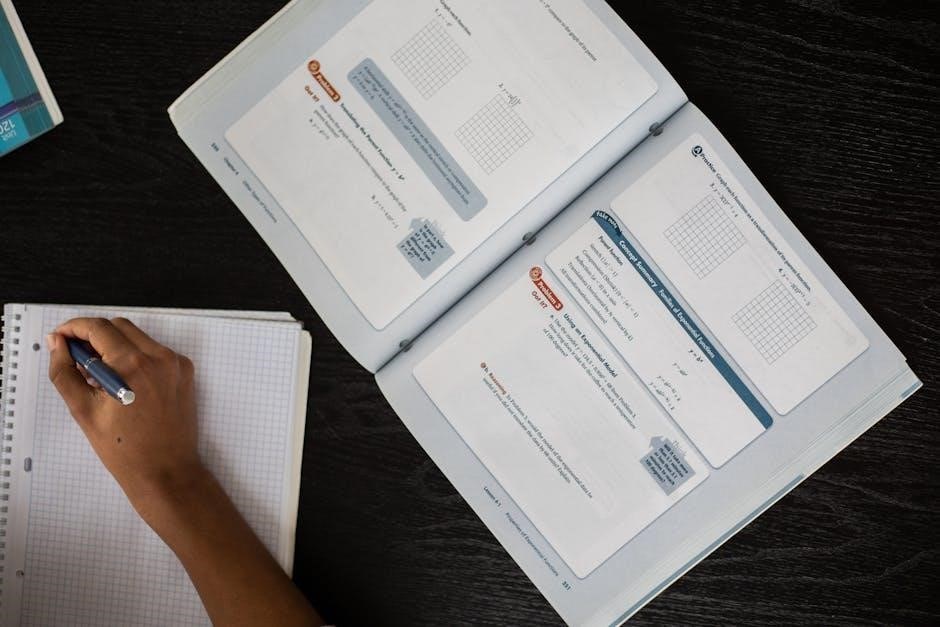
Foundations of Mathematics 11 places a strong emphasis on proportional reasoning, a fundamental skill applicable across numerous mathematical disciplines and real-world contexts. The textbook meticulously develops students’ understanding of direct and inverse variation, utilizing both numerical and graphical approaches;
Students learn to identify proportional relationships from tables, graphs, and equations, and to translate between these different representations. The concept of scale factors is introduced and applied to problems involving similar figures and map reading. Unit analysis and dimensional analysis are employed to solve problems involving rates, ratios, and conversions.
The curriculum extends to solving practical problems involving proportions, such as calculating dosages, determining costs, and predicting outcomes. Emphasis is placed on setting up proportions correctly and interpreting the results meaningfully. Numerous examples and practice exercises reinforce these concepts, building students’ confidence and proficiency in proportional reasoning.
CD-ROM Component
The Foundations of Mathematics 11 textbook is accompanied by a CD-ROM, measuring 4 ¾ inches in diameter, designed to supplement and enhance the learning experience. This interactive component provides students with additional resources and opportunities for practice beyond the printed material.
The CD-ROM likely contains a variety of features, such as interactive tutorials, step-by-step solutions to selected exercises, and self-assessment quizzes. It may also include dynamic visualizations of mathematical concepts, helping students to develop a deeper understanding of abstract ideas. Further enrichment could be found in the form of additional practice problems with varying levels of difficulty.
The CD-ROM serves as a valuable tool for both independent study and classroom instruction, allowing students to reinforce their learning at their own pace. It provides immediate feedback on their progress, helping them to identify areas where they need further support. The inclusion of this digital component reflects a commitment to modern pedagogical practices.
Target Audience and Educational Level
Foundations of Mathematics 11 is specifically designed for students currently enrolled in, or preparing to enroll in, a Grade 11 mathematics course. This textbook serves as a core resource for high school students building upon their prior mathematical knowledge from earlier grades.
The content is tailored to meet the curriculum expectations for a foundational mathematics course at the secondary level. It aims to provide a solid base for students who may pursue further studies in mathematics, science, engineering, or related fields. The textbook’s scope and sequence are aligned with provincial or state standards for Grade 11 mathematics.
It is intended for students who require a comprehensive and accessible approach to key mathematical concepts. The textbook’s development involved numerous writers and consultants dedicated to delivering the best possible mathematics education. It’s suitable for both university-bound and college-bound students seeking a strong mathematical foundation.
Authors and Consultants
Foundations of Mathematics 11 represents a collaborative effort, meticulously developed by a dedicated team of writers and consultants. While the specific names of individual authors aren’t explicitly detailed in the available source information, the textbook’s description emphasizes the extensive expertise brought to its creation.
This collective team comprised experienced mathematics educators, curriculum specialists, and subject matter experts. Their combined knowledge ensured the textbook’s content is accurate, pedagogically sound, and aligned with current educational best practices. The consultants likely provided valuable insights into student learning needs and effective teaching strategies.
The commitment to assembling a highly qualified team underscores the publisher’s dedication to providing a superior learning resource. This collaborative approach aimed to deliver the “very best of mathematics” to students, ensuring a comprehensive and engaging learning experience. The textbook benefits from diverse perspectives and a shared passion for mathematics education.
Publication Date and Edition
According to the Internet Archive metadata, Foundations of Mathematics 11 was initially published on April 24, 2021. This date signifies when the digital version of the textbook was added to the archive, facilitating broader access to this educational resource.
The specific edition of the textbook isn’t explicitly stated in the provided information; however, the archive entry suggests it represents a complete and readily available version for download and study. The “Committed to retain 20170101” notation indicates a preservation effort, potentially referencing an earlier version or a commitment to long-term archiving.
The availability of this textbook on the Internet Archive ensures students and educators can access a valuable learning tool. The publication date provides context for the curriculum’s relevance and alignment with contemporary mathematical standards. Further details regarding specific revisions or updated editions would require additional research beyond the current source.
Accessibility and Download Options
Foundations of Mathematics 11 is readily accessible through the Internet Archive, offering multiple avenues for access and download. The textbook is categorized as an “Access-restricted-item,” implying certain usage limitations may apply, though it is still available for viewing and borrowing.
The Internet Archive provides options for both online reading and digital download. Users can “Borrow” the textbook for a limited time, or explore options for permanent access depending on Archive policies. The item size is substantial at 1.4GB, so a stable internet connection is recommended for downloading.
The platform supports various embedding options for integration into websites or learning management systems. Furthermore, the Archive encourages users to contribute to its preservation efforts. The “Copy Link” feature facilitates easy sharing of the resource. The Internet Archive’s commitment to open access makes this textbook a valuable resource for students and educators globally.
Potential Uses for Students
Foundations of Mathematics 11 serves as a core resource for students navigating key mathematical concepts. The textbook comprehensively covers inductive and deductive reasoning, laying a strong groundwork for logical thinking and problem-solving. Students can utilize it to master properties of angles and triangles, essential for geometry and trigonometry.
The included sections on acute and oblique triangle trigonometry provide a solid foundation for advanced mathematical studies. Furthermore, the textbook aids in understanding statistical reasoning, systems of linear inequalities, and quadratic functions – all crucial skills for various disciplines.
The proportional reasoning chapter enhances analytical abilities, while the accompanying CD-ROM offers interactive exercises and supplementary materials. Students can leverage this resource for homework assistance, exam preparation, and reinforcing classroom learning. The textbook’s detailed explanations and examples promote independent study and a deeper grasp of mathematical principles.

Potential Uses for Educators
Foundations of Mathematics 11 provides educators with a structured and comprehensive curriculum resource. The textbook’s coverage of topics – from inductive and deductive reasoning to quadratic functions – allows for a thorough exploration of essential mathematical concepts. Teachers can utilize the material to build lesson plans, create assessments, and deliver engaging classroom instruction.

The detailed explanations and examples within the textbook facilitate effective teaching and cater to diverse learning styles. The inclusion of acute and oblique triangle trigonometry sections enables educators to introduce these concepts in a clear and accessible manner.
Furthermore, the CD-ROM component offers supplementary materials and interactive exercises, enhancing the learning experience. Educators can leverage the textbook to foster critical thinking, problem-solving skills, and a deeper understanding of mathematical principles among their students. It’s a valuable tool for both new and experienced mathematics instructors.
Related Educational Resources

While Foundations of Mathematics 11 serves as a core resource, educators and students can supplement their learning with materials available through the Internet Archive. The Archive offers access to a vast collection of digitized books, including related mathematical texts and historical resources.
Open Library, a project of the Internet Archive, provides a platform for discovering and accessing a wide range of books, potentially including supplementary materials for advanced mathematical study or foundational concepts.
Furthermore, the Internet Arcade and Librivox Free Audio sections of the Archive, though not directly mathematical, can offer engaging breaks and alternative learning experiences. For broader academic support, resources like American Libraries and digitized collections from institutions like the Metropolitan Museum can foster interdisciplinary connections. The Archive’s Wayback Machine allows exploration of past websites related to mathematics education.
Copyright and Usage Restrictions
Access to the Foundations of Mathematics 11 textbook PDF through the Internet Archive is governed by copyright regulations and the Archive’s terms of service. As an access-restricted item, usage is subject to limitations designed to protect the intellectual property rights of the authors, Nelson Education (the publisher), and any contributing consultants.
Users are generally permitted to borrow and read the digital copy for personal educational purposes. However, unauthorized distribution, reproduction, or commercial use is strictly prohibited. Downloading and sharing the PDF outside of the Archive’s lending system constitutes a copyright violation.
The Archive’s commitment to retaining the resource (as noted with the “Committed to retain 20170101” marker) does not imply unrestricted usage. Users should review the specific license associated with the item on the Archive’s website to understand the permissible scope of access and use. Respecting these restrictions ensures continued availability for all learners.